
Speaking Strategy
PTE Summarize Group Discussion:
PTE Summarize Group Discussion:
How to Structure Your Answer
You do not need to repeat everything you heard. You need a system for taking notes and a steady way of speaking. Here is what I teach.
Quick Answer
Speak for about one minute of the two you are given. Keep your introduction to around five seconds, then give roughly 20 seconds to each speaker. Take short notes, call every speaker "they," and speak in a steady, lower voice like a news reporter. Flow matters more than including every detail.
Most students try to repeat everything they heard. That is what causes the hesitating, the rushing, and the running out of time. You do not need everything. You need enough, delivered smoothly.
Timing — 01How Long to Speak
You are given two minutes. You do not need to use them.
Introduction~5 sec
Each speaker~20 sec
Total1:00 – 1:05
One minute to one minute five seconds is enough for scoring. Treat the total as the target and the 20 seconds as a pacing guide. If there are more speakers, give each one a little less rather than going over the total.
For the timings across every speaking task, see PTE Speaking Times: How Long You Should Actually Speak.
Keep the introduction short. Around five seconds. It is not where your marks are. Get into the speakers quickly.
Notes — 02Keywords or Phrases?
This depends on your level, and getting it wrong will cost you.
If you can build sentences from single words
Take about six keywords per speaker. Keywords are faster to write, which means less time looking down and more time listening. Six per person is usually enough to talk from without hesitating.
If you cannot do that yet
Keep writing short phrases instead.
Keywords only work if you can turn them into full sentences under pressure. If you switch to keywords before you are ready, you will look at a single word, freeze, and lose more time than the notes saved you. Phrases are slower to write but safer to speak from.
Move to keywords when you can build sentences from them in practice. Not before.
Do not try to write full phrases for everything. Whichever method you use, writing down every detail is not manageable in the time you have. Capture enough to speak from, not everything that was said.
Notes — 03Call Every Speaker "They"
Do not try to track who was male and who was female.
Use "they" for everyone. It removes a decision you do not need to make while you are speaking, and it stops you hesitating over a pronoun or correcting yourself halfway through a sentence.
It also means you do not have to catch or remember names. One less thing to get wrong.
Delivery — 04Sound Like a News Reporter
Keep your pitch steady and lower than your normal speaking voice.
In everyday conversation, people's voices rise at the end of sentences. That rising intonation makes you sound uncertain, and it does not suit a summary. A news reporter delivers information at a consistent, level pitch. That is the tone you want here.
A lower, steadier voice is also easier for the scoring system to pick up clearly.
Your equipment matters here too. See Test Your Microphone Before the Official PTE Mock Test.
Structure — 05I Never Give a Conclusion
You do not need to finish with a closing sentence. I never give one.
Summarise what each speaker said, and stop. A conclusion adds time without adding anything the scoring system is looking for, and rushing to fit one in is how people end up speaking too fast at the end.
This is not a guess. I have scored 90 in speaking on four consecutive attempts doing it this way.
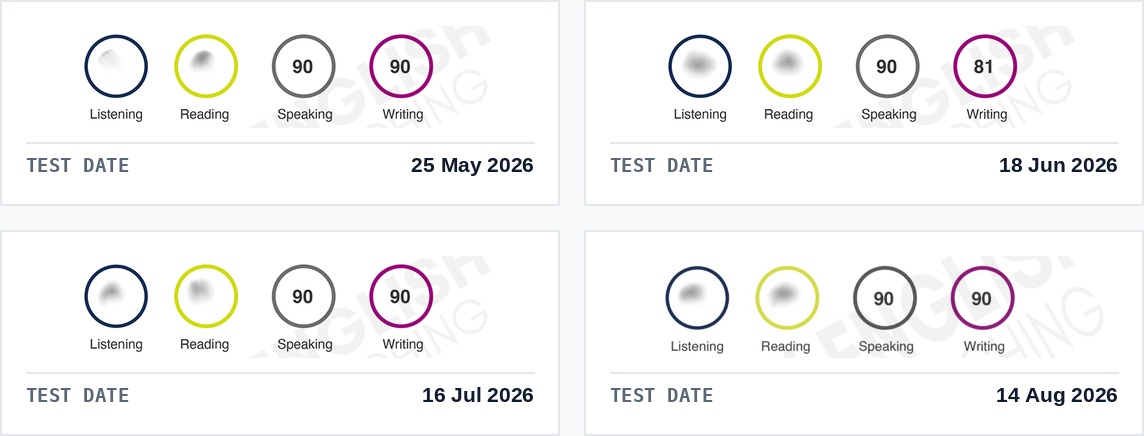
Speaking 90 on four consecutive attempts — May, June, July and August 2026.
Delivery — 06Flow Beats Detail
You will not fit everything in your notes into one minute. You are not supposed to.
If you make a small mistake, keep going. Do not stop, do not go back, do not correct yourself. A smooth summary that misses a detail scores better than a complete one full of pauses.
Frequently Asked Questions
How long should I speak in Summarize Group Discussion?
About one minute to one minute five seconds, out of the two minutes you are given. Around five seconds for the introduction and roughly 20 seconds per speaker.
Should I take keywords or full phrases in my notes?
It depends on your level. If you can build sentences from single words, take about six keywords per speaker. If you cannot do that yet, keep writing short phrases — keywords will only make you hesitate.
Do I need to say whether each speaker was male or female?
No. Use "they" for every speaker. It saves you tracking gender or names and stops you hesitating over pronouns.
Do I have to include every point from the discussion?
No. You will not fit everything into one minute and you are not expected to. A smooth summary that misses a detail scores better than a complete one with pauses.
Do I need a conclusion in Summarize Group Discussion?
No. I never give one. Summarise what each speaker said and stop. A conclusion uses time without adding marks, and I have scored 90 in speaking on four consecutive attempts without one.
What tone should I use?
A steady, lower pitch, like a news reporter. Avoid the rising intonation people use in conversation, because it sounds uncertain and is harder for the scoring system to read.
Practise This With Feedback
Every technique taught in our program is tested against the real PTE exam under the current scoring system.
Join the Program