
Speaking Strategy
PTE Speaking Times:
PTE Speaking Times:
How Long You Should Actually Speak
You get 40 seconds. You do not need to use all of them. Here are the speaking times we found after 25 real exams.
Quick Answer
Speak for about 25 seconds in Describe Image, Retell Lecture and Respond to a Situation, even though you are given 40. In Summarize Group Discussion, speak for about 1 minute of the 2 you are given. Make your point, then press next. Speaking longer gives you more chances to make mistakes.
Most students try to fill the whole time. They think more speaking means more marks. It does not. Here is what we found after testing this on the real exam.
Times — 01The Speaking Times
This is how long I aim to speak in each task.
TaskSpeak this long / time given
Describe Image
25 / 40 seconds
Retell Lecture
25 / 40 seconds
Summarize Group Discussion
1 / 2 minutes
Respond to a Situation
25 / 40 seconds
Say what you need to say, then press next. Do not wait for the timer to finish.
For the full strategy behind Respond to a Situation, including practice scenarios, read PTE Respond to a Situation: The Complete Strategy.
Retell Lecture also has its own five-step structure. See PTE Retell Lecture: Stop Freestyling and Use a Structure.
Evidence — 02Why I Trust These Times
It has been a year since the exam changed. In that time, my colleague and I have taken the PTE exam 25 times.
We tested different speaking techniques and different speaking times. For a long time the results were not consistent. Some attempts worked. Some did not.
Then the last four tests came back the same: 90, 90, 90, 90. That is when I became confident in these times.
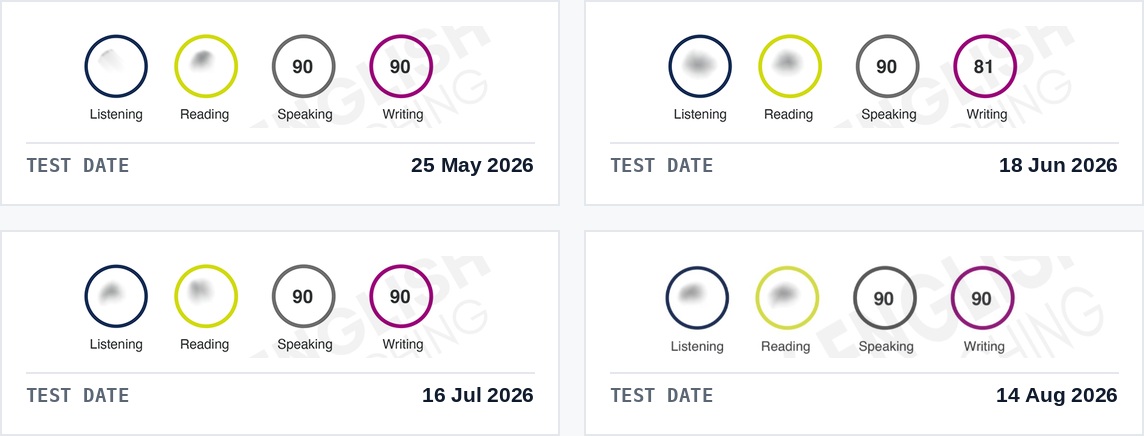
Speaking 90 on four consecutive attempts — May, June, July and August 2026.
Why Listening and Reading are hidden. On these attempts we did not answer the Listening and Reading questions at all. We were testing Speaking and Writing only, so those scores are meaningless and we have blurred them out. This is also why the Overall score on each report looks low — it is pulled down by two sections we deliberately skipped.
This is real testing, not theory. These times come from sitting the exam again and again and comparing the results — including the attempts that did not work.
Reason — 03Why Speaking Less Works Better
The longer you speak, the more chances you have to make a mistake.
Extra time is when students hesitate, repeat themselves, lose their flow, or start saying things that are not relevant. None of that helps your score.
So why do more when you can do less? Say your point clearly, then stop.
Plan — 04Have a Plan Before You Sit Down
Do not decide how long to speak while you are in the exam. Know your target time before you walk in.
Practise with a timer. Get used to how 25 seconds feels. When you can hit that time without thinking about it, you can focus on what you are saying instead of watching the clock.
The same idea applies to writing. If you want a fixed plan for the essay, see PTE Essay Writing: The Sentence-by-Sentence Outline.
Frequently Asked Questions
How long should I speak in PTE Describe Image?
About 25 seconds, even though you are given 40. Make your point clearly, then press next.
Do I lose marks if I do not use all 40 seconds?
No. We tested this across 25 real exams. Using the full time did not improve the score. The last four attempts using shorter times all scored 90.
How long should I speak in Summarize Group Discussion?
About 1 minute of the 2 minutes you are given.
Why is speaking for longer a problem?
More speaking means more chances to hesitate, repeat yourself, or go off topic. Those mistakes cost you marks. A short, clear answer is safer.
Why are Listening and Reading blurred on your score reports?
Because we did not answer those sections. These attempts were used to test Speaking and Writing only, so the Listening and Reading scores mean nothing. It is also why the Overall score on each report looks low.
Should I wait for the timer to run out before moving on?
No. Once you have made your point, press next. There is no benefit to sitting in silence or filling time.
Techniques Tested on the Real Exam
Every technique taught in our program is tested against the real PTE exam under the current scoring system.
Join the Program